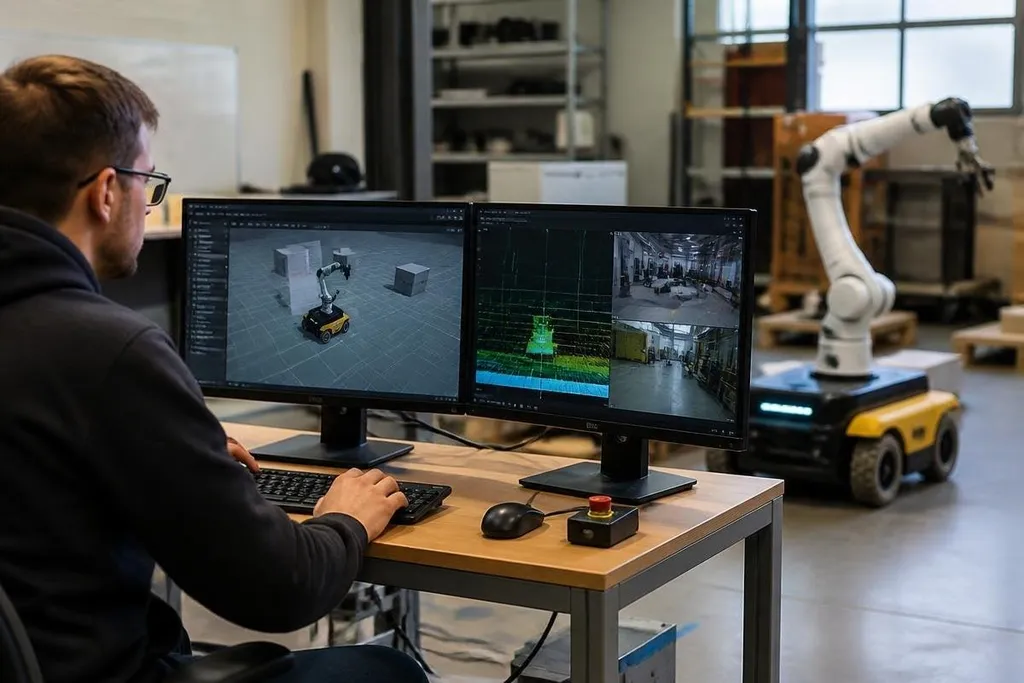
A robot can repeat the same lift, turn, or drive hundreds of times inside a simulator before anyone powers the hardware. That lets a team check control code, sensor data, and task plans while the physical robot is still being built.
For an engineer working on a mobile robot or robot arm, the useful question is simple: which parts of the job can a virtual world test well, and which still need hardware?
- Motion code can run against a simulated robot model.
- Camera and LiDAR data can feed the same type of software used on the machine.
- Contact, wear, and safety behavior still need checks on real equipment.
What the virtual robot contains
A training world gives software a model of the robot, its surroundings, and the task. The model can include links, joints, motor limits, wheel size, arm reach, collision shapes, and the mass of each part.
A physics engine then calculates how the model moves when software sends commands. A joint command changes the arm angle. A wheel command changes the robot’s speed. If the model hits a wall, the engine can report contact instead of letting the robot pass through it.
Sensors can be simulated too. A virtual camera creates image data, while a virtual LiDAR creates distance readings. The control software can read those inputs through the same message structure used on the physical robot, often through a robotics framework such as ROS 2.
That common software path matters. A team can find a bad camera setting, a wrong joint limit, or a timing problem before the robot reaches the floor.
How training moves from software to hardware
Many teams use reinforcement learning for tasks such as walking, gripping, or keeping balance. The software tries an action, receives a score, and changes its next attempt based on the result. A virtual world can run these trials much faster than a person can reset a physical test.
The training world must include variation. A robot that sees one fixed table, one light level, and one floor surface may learn a narrow answer to a narrow task. Teams can vary friction, object position, camera noise, motor strength, and lighting so the control system faces a wider set of conditions.
This method is often called domain randomization. Its purpose is practical: reduce the gap between clean virtual data and messy sensor readings on a real machine. The gap still exists, because a simulator cannot predict every cable bend, loose screw, soft object, or floor mark.
That gap gives virtual training a practical test: can a real robot repeat the task when lighting, floor grip, or object weight changes? Robot24.com’s reports on real robots can tie that result to a named machine and test setting before the next section looks at where virtual training falls short.
Where virtual training falls short
Contact is difficult to copy. A gripper may press into rubber, slide across cardboard, or crush a thin object. Small errors in surface friction or object shape can change the result.
The same problem appears in walking robots. A foot may land on a smooth patch, a rough patch, or a floor joint that the virtual model does not include. Motor heat, battery voltage, gear wear, and cable drag also change how the physical robot responds.
Safety needs a separate check. A simulator can test whether software stops when a virtual person enters a marked area. It cannot prove that a real emergency stop, brake, power circuit, or protective scanner works under every fault.
I’d trust virtual training for early software work, then require physical tests before the robot handles people, heavy loads, or valuable stock.
A practical decision guide
Use this check before moving a trained controller onto hardware:
- Match the model: confirm mass, joint limits, wheel diameter, motor torque, and sensor position.
- Vary the world: change lighting, friction, object location, and sensor noise during training.
- Check timing: compare command delays and sensor rates between the simulator and the robot.
- Start with low risk: test slow speeds, empty grippers, and clear floors before live work.
- Record failures: log contact errors, missed detections, motor heat, and safety stops.
- Set a stop rule: define the result needed before the robot can run without close supervision.
The next step is a measured handoff, not a single successful simulation run. A virtual world can cut early trial time and expose software faults, while the physical robot decides whether the training holds up under contact, noise, heat, and real safety limits.